
Cutting the Cord by Untangling Historical Issues, Legislation, Technical Classifications of Legacy Cables, and Cable Owner Liability within the Belgian North Sea.
The Belgian Part of the North Sea (BPNS) is a vital maritime region, hosting a dense network of subsea cables that play essential roles in telecommunications, electricity transmission, and offshore energy activities. As these cables approach or exceed their operational lifespan, the question of their decommissioning (whether through repurposing, removal, or abandonment) has emerged as a concern. This research sets the stage by exploring the legal, technical, and environmental dimensions of subsea cable decommissioning, providing the necessary context to understand the challenges and complexities involved.
Subsea cables are not uniform; they differ materially in function, route, ownership, permit status and legal regime. For this study, the principal functional categories are telecommunications cables, electricity interconnectors, export and inter-array cables serving offshore energy projects, and other cables connected with activities under Belgian jurisdiction. The legal analysis does not depend on a fixed number of engineering subtypes. It turns primarily on the cable’s route, function, connection with offshore resources or installations, applicable permits and ownership structure.
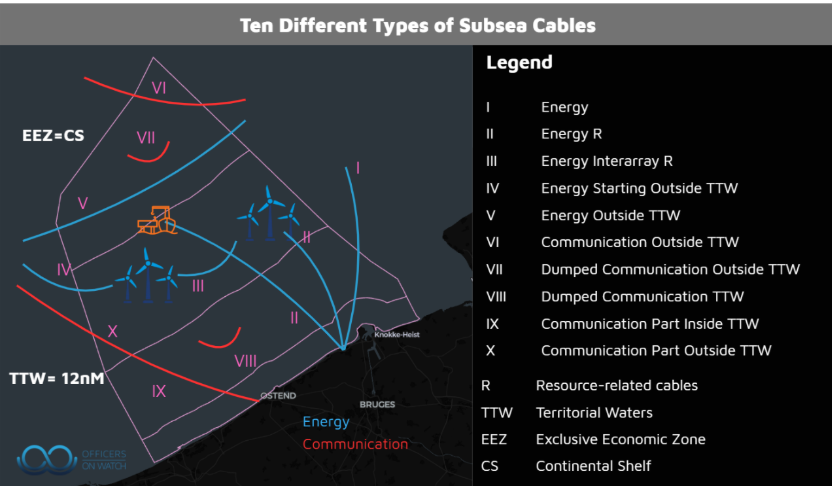
Ten Different Types of Subsea Cables
The BPNS comprises distinct maritime zones. In the territorial sea, extending up to 12 nautical miles from the baselines, Belgium exercises sovereignty. In the EEZ and on the continental shelf—which are geographically coextensive for Belgium but legally distinct - Belgium exercises the specific sovereign rights and jurisdiction granted by UNCLOS rather than general territorial sovereignty. For non-resource-related cables, those powers must be reconciled with other States’ cable freedoms under Articles 58 and 79.1

Overview on zone, cable context, and core legal basis
For the purposes of this report, “decommissioning” means the set of activities and associated decisions undertaken at the end of the operational life, including the planning and execution of its removal, disposal or other end‑of‑life management, as well as any related measures intended to address safety, environmental protection and restoration of the maritime area. Depending on the applicable legal and factual circumstances, it may include disconnection, making safe, monitoring, repurposing, partial or full removal, authorised retention in situ, waste treatment and seabed restoration. Use of the term does not by itself imply that full removal is legally required.
The appropriate end-of-life measure must be determined cable by cable by balancing the applicable legal obligations, permit conditions, technical feasibility, navigational risk, environmental effects, future seabed use and proportionality. Full or partial removal may be required in some settings; in others, authorised and monitored retention in situ may be preferable to the disturbance caused by recovery. Neither outcome should be presumed without assessment.
The study therefore applies five complementary dimensions of classification: technical, hydrographic, operational, economical, and legal. The overview contains five classification rows plus one separate “regulatory” row showing potential authority measures.
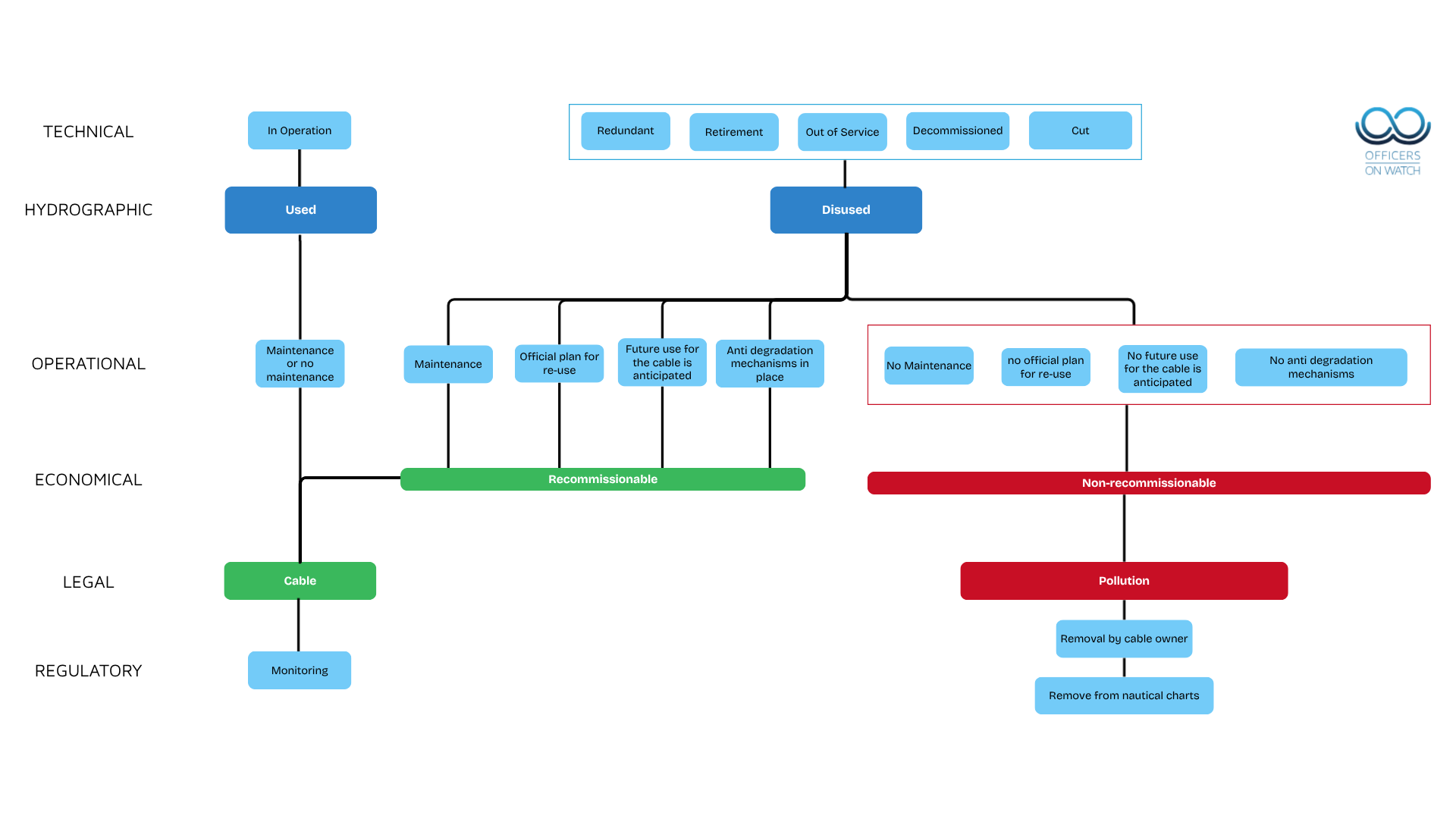
The 5D Framework for Subsea Cable Decommissioning Classification
Historically, numerous legacy cables in the BPNS appear to have remained in place after service ceased. The available records do not always establish whether this resulted from an authorised end-of-life decision, a formal decommissioning process, a temporary retention strategy or de facto abandonment. This report therefore uses each status term only after a cable-specific review of the supporting evidence.
The resulting questions are not limited to whether a cable is still fully functioning. They include whether the cable has a credible reuse function, whether the owner and permit holder remain identifiable, whether post-operational duties continue, and what further assessment or measure is legally justified. An out-of-service designation is an important input, but not an automatic trigger for removal.
The UK-Belgium 1 cable, laid in 1958 from Middelkerke, illustrates the age of part of the legacy infrastructure in the BPNS. The dense combination of active and disused cables can create risks for anchoring, fishing, cable crossings and other future uses of that area. Environmental concerns must be assessed cable by cable on the basis of material composition, condition, exposure and the comparative effects of leaving the cable in place or recovering it.
Demand for new connections, including infrastructure associated with the Princess Elisabeth Zone, also increases pressure on available seabed corridors. Legacy cables can complicate marine spatial planning, crossing design and the permitting of new infrastructure. Unlike offshore installations, non-resource-related cables are not subject to a single, comprehensive international decommissioning regime, which makes a consistent cable-specific method necessary.
Unless otherwise stated, numerical findings in this report refer to the “BPNS Subsea Cable Geospatial Database – Research Snapshot, data cut-off 20 June 2026” (the Research Snapshot). In that snapshot, 24 cable records are classified for potential decommissioning. This is a research screening status and does not by itself establish legal abandonment, pollution, a duty to decommission or a duty to remove.
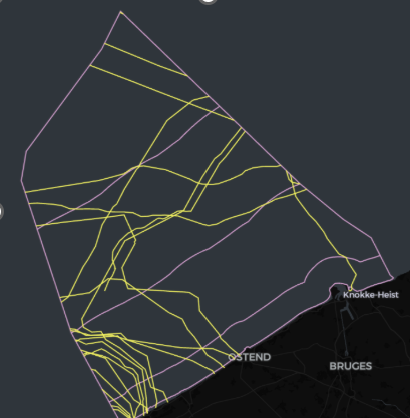
Twenty-four cable records classified as disused in the Research Snapshot (data cut-off 20 June 2026)
The legal analysis must precede any decision on decommissioning or removal. The 1884 Convention primarily protects submarine cables and allocates specific repair-cost liabilities and compensation mechanisms; it does not establish a general end-of-life regime. UNCLOS preserves cable freedoms while granting coastal States defined powers in the territorial sea, EEZ and continental shelf, including environmental jurisdiction. It does not contain a general removal obligation for non-resource-related cables.
The OSPAR Convention contributes to the regional marine environment framework but does not itself impose a general cable-removal obligation. Belgium’s authority is broadest in the territorial sea. In the EEZ and on the continental shelf, it must rely on the specific powers conferred by UNCLOS and Belgian law, including powers relating to resources, offshore installations, marine environmental protection, flag or nationality, and applicable permit conditions. A mandatory measure for a non-resource-related cable therefore requires an identifiable legal basis and due regard to the rights of other States. Belgian legislation and individual permits may add cable-specific obligations within their material, geographic and temporal scope.
This research aims to clarify whether, and on what legal basis, Belgium may require cable owners to remove permanent out-of-service subsea cables in accordance with international and Belgian national law. The goal is to transform the current tangled web of cables into a well-managed, orderly system that ensures navigational safety, prevents environmental harm, and accommodates future cable infrastructure in a sustainable manner.
While this research focuses on the legal analysis of decommissioning obligations for telecom and energy cables in the BPNS, it acknowledges that technical and environmental considerations, such as removal methods and ecological impact, are also important. However, these aspects are not the primary focus. Instead, the research aims to clarify Belgium’s rights and obligations underinternational and national law, identify legal gaps that hinder effective decommissioning, and propose actionable recommendations for a coherent decommissioning strategy. All legal and technical aspects discussed will be compiled into a database overview for further reference and practical application.
The central regulatory challenge is not the absence of applicable law, but the absence of a single piece of legislation that resolves every legacy-cable case. A legally sound strategy requires consistent status definitions, a verified chain of ownership and permit history, reliable cable data, and a documented assessment of jurisdiction, environmental and navigational risks, applicable conditions and proportionality.
The study accordingly supports a cable-specific prioritisation method. It identifies records requiring further investigation and distinguishes this screening step from any subsequent legal decisions as to whether a cable is considered abandoned, dumped or pollution, and whether decommissioning, including full or partial removal, monitoring, and mitigation measures, is justified.
Belgium may impose end-of-life measures where a recognised jurisdictional basis applies. A disused, cut or owner-unverified cable does not automatically constitute pollution or dumping, and removal is not the automatic remedy.
The immediate priorities are to verify ownership and permit history, complete the Research Snapshot with source and confidence fields, apply the five-dimensional Cable Decommissioning Assessment, and determine the lawful and proportionate measure for each prioritised cable.