
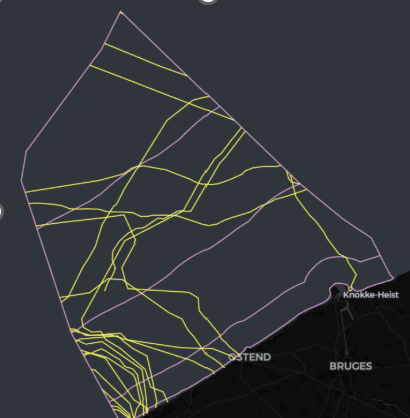
Twenty-four cable records classified as disused in the Research Snapshot (data cut-off 20 June 2026)
The fragmentation of cable data across multiple national, European, and sectoral databases including Flemish Hydrography, Kingfisher, EMODnet, CICA, SHOM, and Rijkswaterstaat creates operational, legal, and navigational risks. A centralised, managed BPNS Subsea Cable Databank is therefore strongly advised to provide a single source of truth for cable-related decision-making on decommissioning.
The BPNS Subsea Cable Databank should capture all subsea cables within Belgium’s maritime zones, including telecommunications cables, electricity interconnectors, export cables, inter-array cables, and legacy cables. The database developed during this study compiles all the known cables and requires continued governance, defined data ownership, periodic verification and a documented update process.
To balance transparency with security and confidentiality, the database should employ a tiered access model. Technical and environmental information should be available to the persons who need it, while precise infrastructure, commercial, security and personal data may require controlled access under the applicable confidentiality, data-protection and access-to-information rules. “Public by default” should therefore be qualified by a documented sensitivity assessment.
The comparative review shows substantial variation in the availability and detail of out-of-service cable information. Belgium should promote a common data model and interoperable identifiers through existing initiatives such as Kingfisher and EMODnet, while maintaining a controlled national record that links public, restricted and permit-specific information. Priority fields include source and confidence, ownership and succession, permit status, hydrographic status, technical condition, repeaters, interventions, crossings, financial security and a credible reuse or end-of-life plan.
Continued enhancement of the Belgian Subsea Cable Database will help authorities and infrastructure owners allocate responsibilities and prepare timely end-of-life decisions. The database supports - but does not replace - the legal, technical and environmental assessment required for each cable.