
Maritime awareness rests almost entirely on AIS: a cooperative signal broadcast by the ship itself and therefore one it can switch off, manipulate or spoof. Synthetic Aperture Radar (SAR) offers a non-cooperative alternative: an active satellite sensor that detects ships, day and night, through cloud and haze, from their radar reflection against the sea surface. Since the completion of the Sentinel-1 constellation (Sentinel-1C and -1D, 2024–2026), C-band SAR data from Europe's Copernicus programme is freely and instantly available through the Copernicus Data Space Ecosystem, without licence fees.
AIS was designed for safe navigation, not for surveillance. The signal originates on board, relayed via satellites (S-AIS) or coastal stations (T-AIS), and it disappears precisely where the threat operates: on the high seas, out of reach of coastal receivers, high-risk vessels switch their transmitters off. The maritime sector calls these "dark vessels". Any surveillance chain that relies exclusively on AIS inherits the system's blind spot. Non-cooperative sensors, sensors that observe the vessel without its cooperation, close that gap. Radar is the oldest and SAR puts that radar on a satellite platform, with global reach.
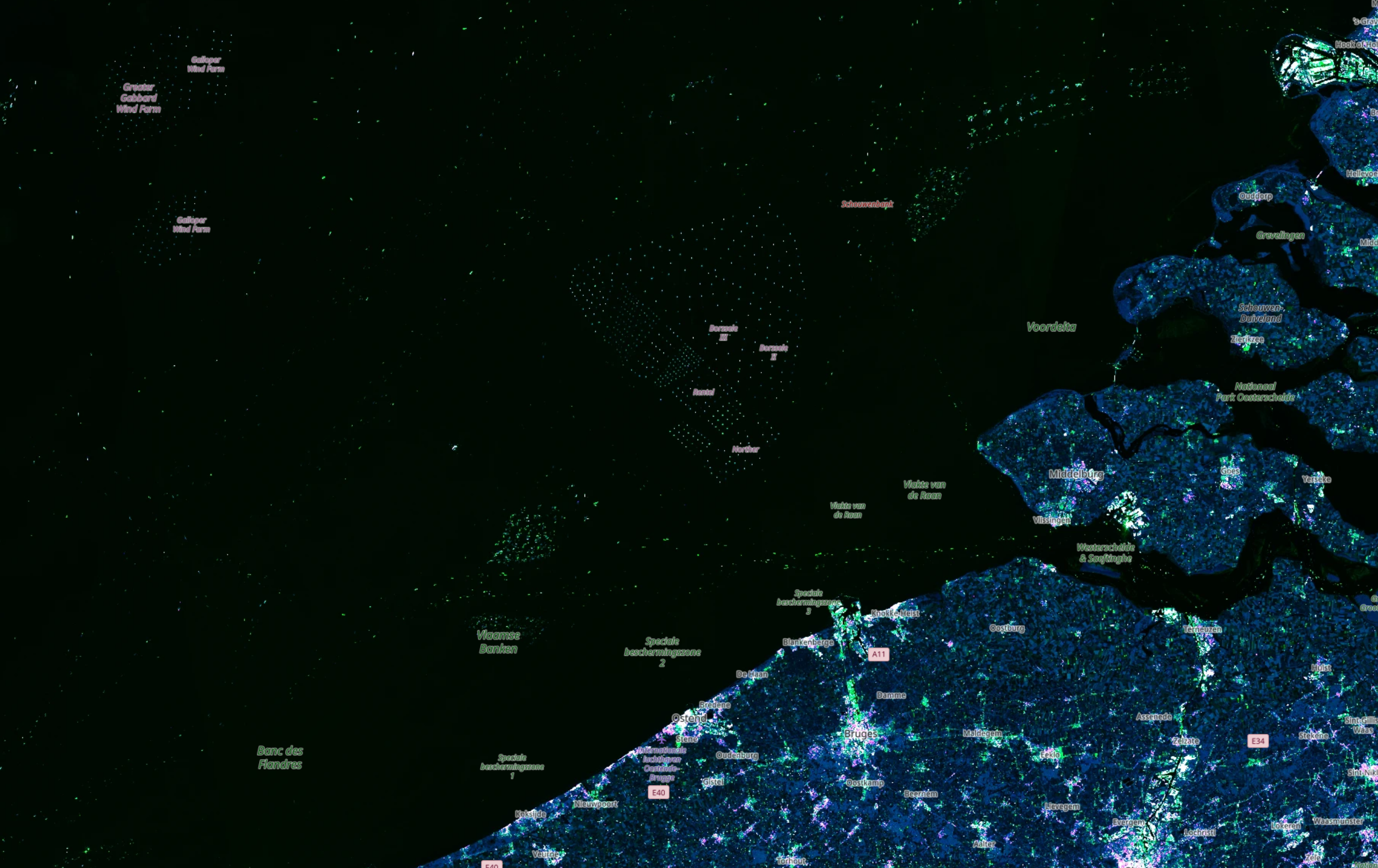
The Belgian North Sea with TSS North Hinder and Offshore Wind Farms
SAR is an active microwave sensor: the satellite transmits radar pulses and measures the backscattered energy. "Synthetic Aperture" refers to the technique by which the moving platform synthesises a much longer virtual antenna, achieving high azimuth resolution from hundreds of kilometres of altitude.
Two properties make SAR exceptionally suited to vessel observation:
Weather independence. Centimetre-scale microwaves (Sentinel-1: C-band, ~5.4 GHz) pass through cloud, haze and darkness. Where optical satellites depend on daylight and a clear sky, SAR delivers an image in any condition — a decisive advantage in the volatile North Sea climate.
Sea–ship contrast. A calm sea surface scatters radar energy diffusely (Bragg scattering off small waves) and appears relatively dark. A ship is an angular metal structure that double-reflects energy straight back to the sensor: a bright point target, often orders of magnitude brighter than the background. The wake — a strip of flattened, rain-out water trailing the ship — is visible too, revealing course and speed.
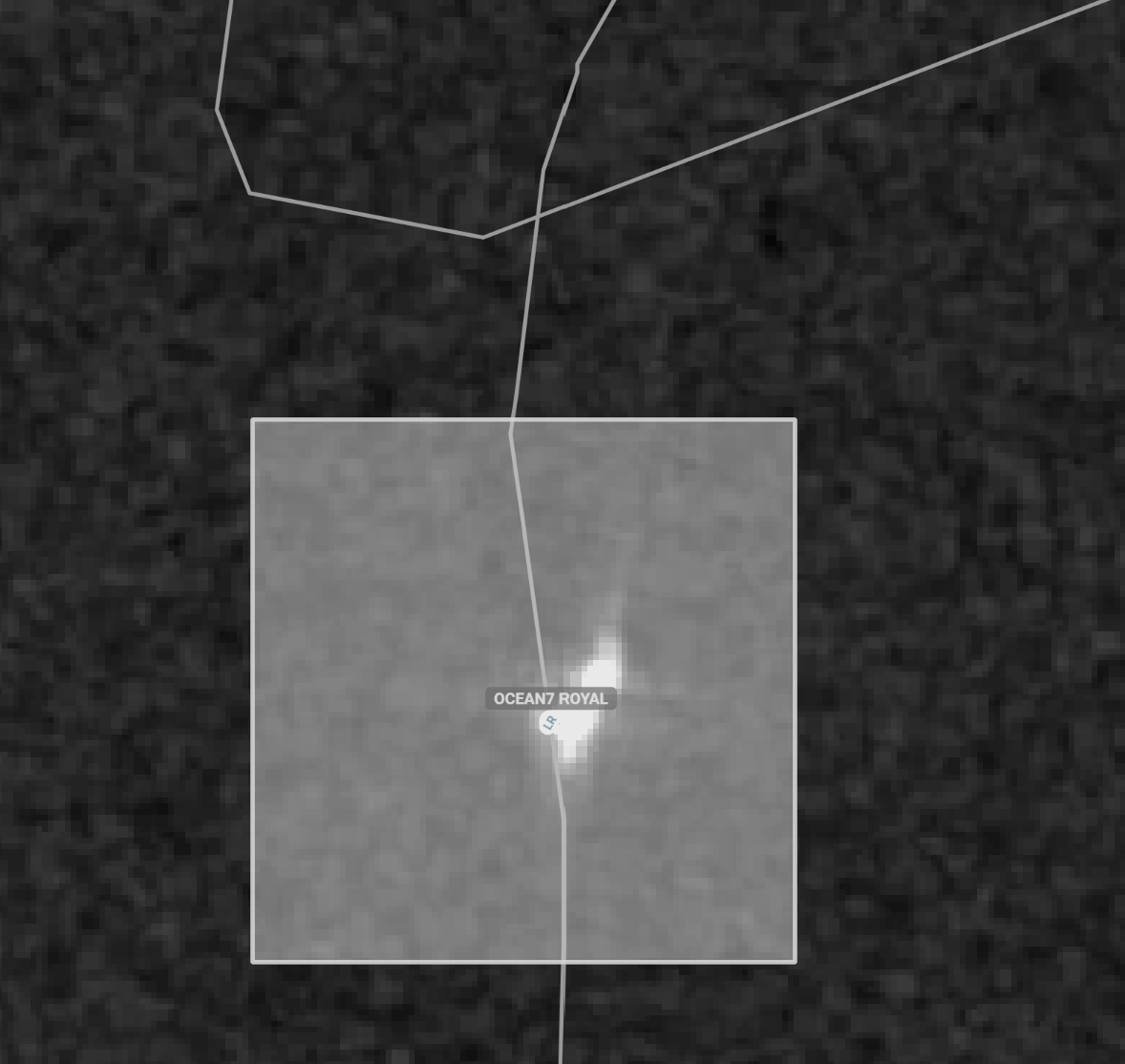
Identified vessel by multifusion of SAR and AIS